
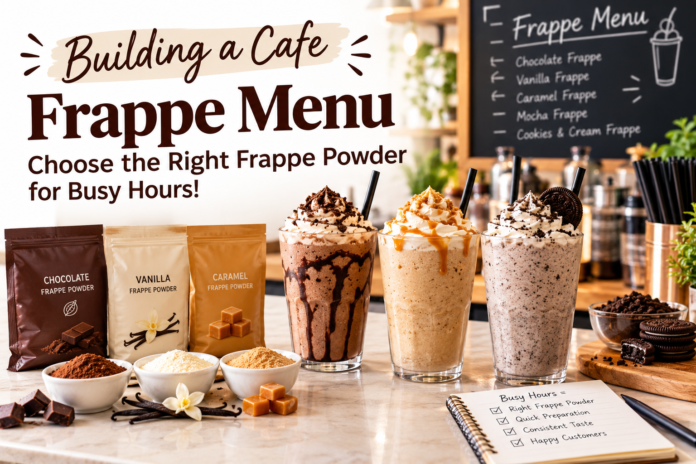
Great flavour names won’t save a cold drinks menu. What matters more is whether the drinks suit your customers, fit the kit you already own, and still work when four orders land together. Each extra garnish or ingredient adds a job for whoever’s behind the counter.
My advice? Start small. Give every drink one clear reason to exist, and run the full serving process before anything goes on the board. You’ll end up with variety built on recipes your team already knows, with room left over for a seasonal special.
Decide Why Each Drink Is There
Look at what people order now and ask where the gaps are. No vanilla option, perhaps. Or no chocolate drink to sit alongside your desserts, or no tea-based choice next to the coffees.
The frappe powder range is a good place to explore this, as it has vanilla, chocolate and matcha mixes for cold drinks. Let real demand and your counter space decide where you begin.
For the first menu, keep it focused to three things:
- Everyday drinks:a few flavours that taste clearly different from each other and are quick to make.
- Add-ons:only extras that already earn their place elsewhere on your menu.
- One signature drink:the fiddlier recipe, saved for a special that’s worth the extra time.
Avoid launching several drinks that differ only by a drizzle or a topping. Why would a customer pick one over the other?
Get the Classics Right First
Make each drink exactly the way the product recipe says, and taste it with no syrup, cream or garnish added. That’s how you learn what the base flavour and texture are really like.
Vanilla frappe powder is the obvious pick for a classic vanilla frappe. The French Vanilla mix also works for smoothies and milkshakes, so once your main recipe is settled, those formats are worth a go.
Fancy adding fruit? Change only that one thing. Jot down how much fruit went in, taste for sweetness, and see how full the cup gets. A recipe that’s balanced without fruit can behave quite differently with it.
Chocolate follows the same logic. Belgian chocolate frappe mix is made for chocolate frappes, smoothies and milkshakes. Taste it plain, then decide whether a topping adds enough to justify one more step at service.
Also taste each drink next to the bakes you plan to sell with it. If the pairing comes across as too sweet or too heavy, change the garnish or the pairing before you touch the base recipe.
Trial It on Your Own Equipment
Stick to the current pack instructions and the recipe for each product. Quantities and blending methods aren’t the same across every mix or drink style, so don’t assume they are.
Use the blender, ice and milk your team will really use on a shift. Write down what goes into the jar and what ends up in the cup.
Before signing off a recipe, run through this list:
- Measurements:weigh the powder and the ice, and measure the liquid properly. Record ice by weight, not by the number of cubes.
- Blending:note the speed setting, the order you load the jar and the blending time.
- Volume:pour into the actual cup, leaving space for any topping you’ve agreed on.
- Texture:check it straight away, then again after the usual wait between counter and table.
- Total time:count all of it, from measuring and blending to pouring, finishing and washing the jar.
When a drink comes out too thin or too thick, compare what you did with your written recipe first. Then change one variable per trial, so everyone knows which tweak made the difference.
Give Matcha Its Own Purpose
Matcha suits you if you want a tea-style flavour next to vanilla and chocolate. The matcha frappe powder contains Japanese matcha and is made for drinks like frappes and shakes. It also contains sugar and milk solids, so treat it as a full beverage mix when you build the recipe.
Start with a plain matcha drink and get your team’s opinion before adding fruit or other flavours. Keep the menu description specific to the finished drink, including its format and main flavours.
Read the ingredients for the whole recipe before making any dietary claims. Swapping the milk won’t take out the milk solids already in the mix.
Make a Layered Special That’s Worth the Effort
Layered drinks give customers something different, but they come with their own workflow. The coconut mango matcha iced latte recipe has a mango purée base, with coconut and matcha layers blended separately. You pour slowly over a spoon to keep the layers apart, and it has to be served straight away.
Try it during a properly busy spell, not a quiet one. Set up the ingredients at your drinks station, make sure you can get a clean blender jar between layers, and use a clear glass so the layers show.
Time the whole assembly before it joins the permanent menu. If it holds up other orders, run it as a limited special until you find a quicker routine.
Turn Your Trials Into a Routine
Every approved drink needs a short recipe card with quantities, steps, cup size and a photo of the finished serve. Then ask a colleague to make it from the card alone. Wherever they get stuck, the instructions have a gap.
Work out cost per serve from the full recipe, including toppings and takeaway packaging. To decide which drinks stay, look at sales, prep time and leftover stock together.
Launch with a selection you can handle, watch how it sells, and build from there. The best menu is the one your customers love and your team can make confidently, even on your busiest day.
To sum up
A good frappe menu doesn’t need an array of flavours or elaborate toppings. It needs the right frappe powder, well-tested recipes and a serving routine your team can manage. Start with what works, pay attention to customer preferences and expand gradually. That’s how you build a drinks menu that performs beyond the quiet hours.